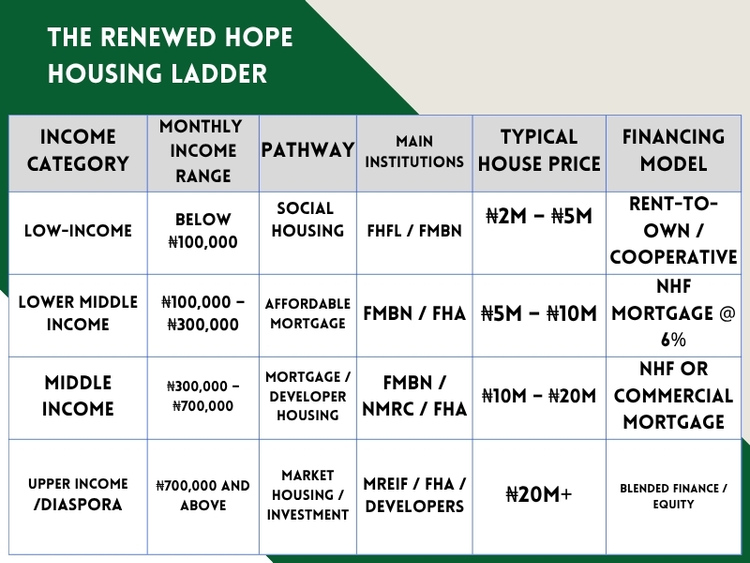
At the core of the Renewed Hope Homeownership strategy is the Housing Ladder Model — a progressive system that allows Nigerians to enter at any level and move upward over time.
This section explains those pathways — from Social Housing for low-income earners, to Affordable Housing Mortgages for middle-income Nigerians, and Private Sector & Developer-Backed Schemes for higher-income groups. Each pathway connects you to one or more federal housing institutions, programmes, and financing products.
Six pathways connect Nigerians to federal housing institutions, programmes, and financing products — matched to income level and employment type, from informal-sector workers to diaspora professionals and institutional investors.
Designed for Nigerians earning less than ₦100,000 per month — artisans, market traders, junior civil servants, and informal workers who often cannot access traditional mortgage finance.
Income: < ₦100,000 / monthA teacher earning ₦70,000 per month can access a 1-bedroom bungalow for ₦3 million at a Renewed Hope Social Housing Estate.
After a modest upfront payment, they can move in and pay monthly rent that gradually converts to ownership over 15–20 years.
Serves Nigerians earning between ₦100,000 and ₦300,000 monthly, typically civil servants, teachers, nurses, and small business owners.
Income: ₦100,000 – ₦300,000 / monthA civil servant earning ₦200,000 monthly can qualify for a ₦10 million NHF mortgage to purchase a 2-bedroom apartment in an FHA or Renewed Hope Estate.
Repayment may be as low as ₦60,000–₦70,000 per month over 20 years.
For Nigerians without formal employment — traders, artisans, transport workers, and entrepreneurs — Cooperative Housing Schemes offer a collective route to homeownership.
A market women's association forms a cooperative of 100 members.
They apply to FMBN for a ₦500 million Cooperative Housing Development Loan to build 100 units. Each woman moves into her unit and pays monthly over 15 years through the cooperative.
For Nigerians earning ₦300,000 to ₦700,000 and above, including diaspora professionals and private-sector employees.
Income: ₦300,000+ / monthA private sector employee earning ₦600,000 monthly buys a ₦15 million apartment at FHA Gwarinpa using an NMRC-refinanced mortgage.
Repayment is spread over 20 years at ~9% interest.
Empowers developers, institutional investors, and high-net-worth individuals to participate in large-scale housing delivery — while enabling end-buyers to access homes through off-take guarantees and rent-to-own structures.
A developer constructs 1,000 units in Ogun State under the Renewed Hope Estate Programme.
MREIF provides an off-take guarantee for 70% of the units; FMBN finances mortgages for buyers; InfraCredit enhances credit guarantees for developers.
An inclusive solution that cuts across all income categories. It allows you to move into your home immediately and pay rent monthly or quarterly — with every payment counting toward ownership.
Homes: ₦2m – ₦15m · Tenure: 15–30 yearsA nurse earning ₦180,000 moves into a Renewed Hope 2-bedroom apartment in Nasarawa for ₦8 million.
Pays ₦60,000 monthly for 20 years — and becomes a full homeowner at the end of the term.
To help Nigerians easily identify where they fit, the Renewed Hope Homeownership Guide provides a self-assessment checklist. Ask yourself:
Every route on the ladder connects to the same goal — a home you own. Start your application today.
Apply for a Home →